Wednesday, August 11, 2010

A Himalayan Pilgrimage

My sadhu friend, Mahatma Sushil, invited me one day to join him on a pilgrimage to the holy lakes at Goseikunda in the Langtang Himalayan region north of Kathmandu.
When I paid him a morning visit, he used to serve me milk tea in his small cave-like lodge in the cliffs behind the Pashupathinath temple,. The milk he had milked himself from a cow that grassed on the top of the hill, next to a beautiful little Krishna mandir.
The next morning, he had asked a friend who knew the mountain track very well, to give us some good advice for the journey. It would be a steep climbing the first two days, he told us, but then the track becomes easier. There are plenty of good lodges along the route. They are equipped with beds and blankets, so there will be no need for carrying with us sleeping bags.
The morning after, my sadhu friend followed me to the Tourism Board to provide the necessary trekking papers, and early next morning we set off by bus to the remote village Dunche at the foot of the Himalayas. Reaching the village in the evening, we took in at the Himalayan View Hotel, a small guest house at the upper end of the village. From here, we could see the steep valley we were to climb next morning. After a morning tea and sweets, we set out on the path. First, we walked along a small river, the water as clear as in the Norwegian mountains. For the first time since I came to Nepal, I could enjoy drinking water out in nature! After a while, we passed a nice looking guest house, built solely in stone, and with small terraces overlooking the river. This would be a perfect place to rest before starting the mountain track!Good to know for a second time.
Now, our hard climbing started. The path turned away from the river that disappeared in a deep gorge beneath us. Our route went into the deep forest that covered the hills on both sides of the valley. After some hours, we took rest on a small glen, surrounded by old pines and rhododendron trees. The sun was warm, birds were singing, and occasionally we could hear bucks roaring – or was it bears? Looking up to the impenetrable forest on the hills that surrounded us, we could very well imagine that this was a home for both bears and tigers . . . .
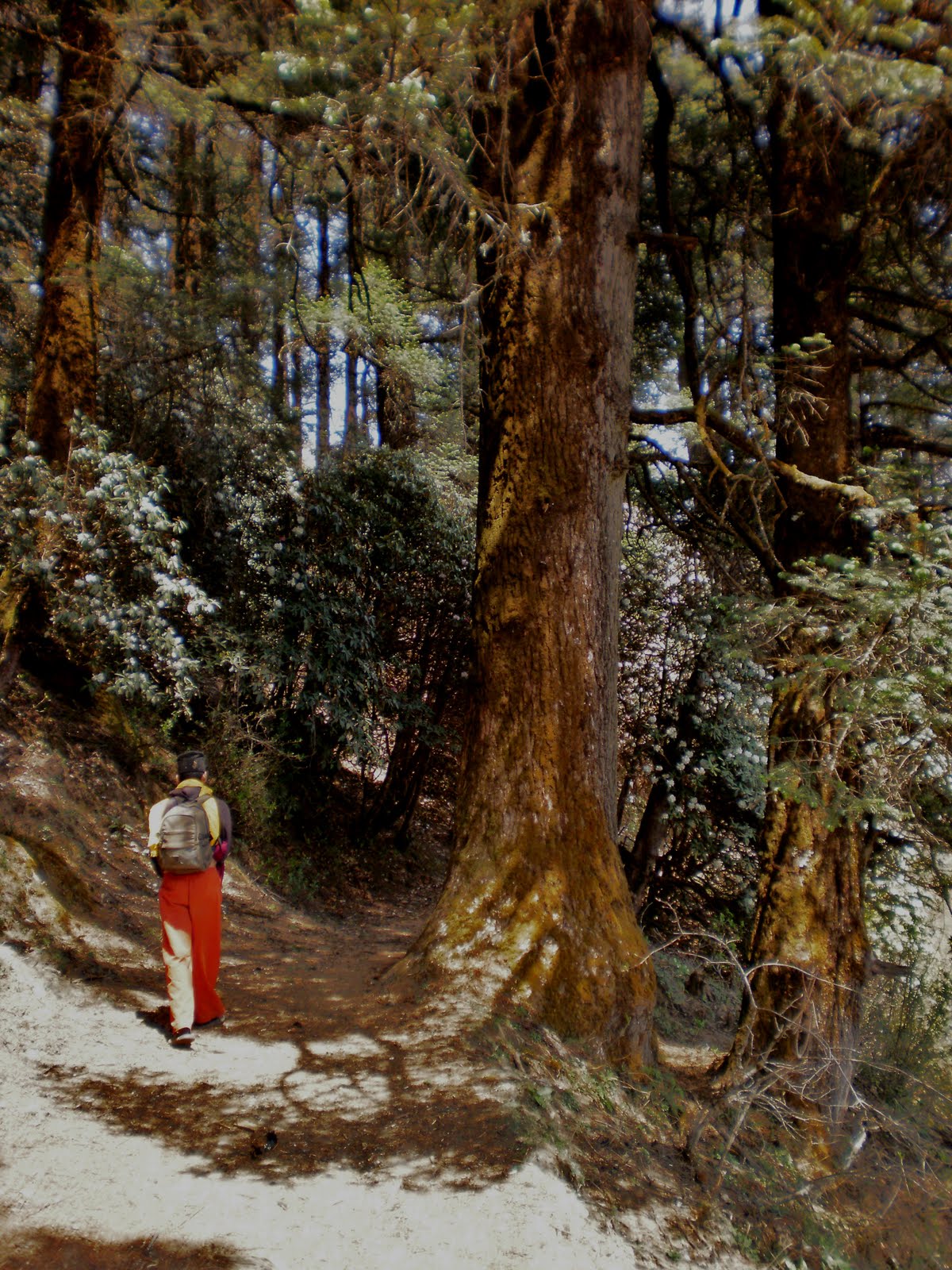
Our aim for the first day was a small gomba or monastery, mid-way up the hills - more than one thousand metres above the Dunche village. The village itself was located at two thousand metres altitude. In the trekking guide, we were recommended to stop overnight at this gomba, to acclimatize ourselves in order to avoid altitude sickness. We followed the advice and continued climbing upwards the next morning. Now, the path was less steep and we soon came into a forest of old, moss covered silver spurs and flowering rhododendron trees. The entire hillside was dotted with red, pink and white flowers – a unique spectacle! Then, along a ridge of the hill, the landscape on the northern side opened and there: The Langtang Himalayan mountains in all their splendour appeared to us! Further along the ridge, a guest house was built on a glen, giving a perfect view of the magnificent mountains. We just had to make a stop for a tea and some refreshments to enjoy the spectacle from the terrace!
Looking east, we could see the path up the steep mountain side, finally disappearing in the clouds. This climb would be even harder than the one we had behind us! I had a knee that troubled me a little, so I got a stick to support me from the kind guest house keeper. She told us that on the top of the mountain ahead, there is a small stupa. Here we will reach an altitude of four thousand metres. Along the steep track, the vegetation became more and more scarce. Instead, small, yellow mountain flowers covered the stony landscape around us. Soon, spots of snow could be seen in the shady areas. The fog enveloped us, and a cold wind blew. Then, the shapes of stupas became visible above us, and soon after, we made a stop by the stone buildings. Now, we found ourselves above the clouds! All around us, an ocean of white clouds covered the lower landscapes, just the snow clad mountain peaks reached up in the blue sky.
The ringing of small bells reached our ears – a group of yaks and horses passed us, heavy loaded with goods for the mountain lodges at Goseikunda. The keepers told us that we were just half an hour away from the famous place.
Turning around a curve of the path, we saw the first lake. On the top of the mountain pass above us, we could at last see the stone buildings of the Goseikunda lodges. We took in at one of the guest houses, in a nice, little room - both ceiling and walls made of pine boards.
A window gave us the view of the largest of the Goseikunda lakes, half hidden in the fog.
After a light evening meal, we made our way down to the shore of the lake. My friend had decided to take a ritual bath in the cold water. The bitter cold and an ice corn shower did not stop him! Wrapped in blankets, he lighted a fire, and we performed a holy ceremony, reading from the Upanishads and the Vedas. Going to bed that evening, I had a headache – we were now at four and a half thousand metres. My breath and pulse were near the double of normal!
I wondered how the night would be like. Anyway, after crossing the mountain pass behind the lakes tomorrow, we would soon come down to lower altitudes.
The next morning I felt a little better. The sunshine and the deep, blue sky cheered me up even more. After a breakfast of roti bread and gee butter, I felt strong enough to continue our route. We walked along the lake, now coloured deep blue, reflecting the sky. Due to the thin air, the colour was considerably darker than in the lowlands. The lack of oxygen forced us to make frequent brakes to regain our breath. The water along the path had frozen during the night. Due to my headache, I felt I could not climb so much higher. But then, we reached the pass, and the stupa covered with Tibetan prayer flags! In Kathmandu, I had bought a string of prayer flags, to set up at this point – nearly five thousand metres up in the Himalayas! Soon, the line of flags waved in the cold wind, whispering their prayers to the gods.
From here, we started our long way down to the lower region of our route. In the evening we reached a desolate guest house, overlooking the valley beneath us. No sooner than we got inside, a sudden ice corn shower started, hammering on the roof and leaving a white layer of ice corns on the ground. The night was cold, but I opened the windows and sat on the bed, meditating and looking out on the moonlit landscape. Out in the dark, the Himalayan night was filled with the cries of owls, foxes and other animals - one of the unforgettable moments of this Himalayan pilgrimage!

Sunday, February 14, 2010

The Shivaratri Festival at Pashupatinath


The Shivaratri is the most important religious event in Nepal. It takes place in the moonless night of lunar calendar month of Phalgun, in February or March according to western calendar. The Pashupathinath Hindu main temple in Kathmandu is the venue for a mela – religious festival – that draw thousands of worshippers not only from Nepal, but from India and Bangladesh as well. It is a celebration of Lord Shiva, and the legend says that on this night, Lord Shiva performed the cosmic dance of creation and destruction.
The Pashupatinath main temple is our local temple, and I often go for a morning walk through the temple ground and up to the old forest, where buildings and ruins of old sanctuaries are spread under the shades of huge, old trees, bearing witness of more than a thousand years of the Hindu culture of Nepal. Walking along the holy Bagmati River, I pass the ghats with the many cremation platforms. Here, funeral pyres burn all day, to cremate the dead bodies of worshippers from all over the country. Further up the river, I come to a gorge, where several caves for hermits are dug out in the steep cliffs. Sometimes I pay a visit to a friend who teaches meditation in one of the hermitages. He often serves me milk tea with fresh milk from the cows that grass on the nearby field. I am also invited to join a fire ceremony in Suriya Ghat, a small temple on the top of one of the cliffs. Here, at a distance from the crowdy temple area, the peace of the forest reigns. Only the sound of the rushing water is heard, mixed with the birds’ song and the chatting of the monkeys up in the trees.
During the Shivaratri, however, sounds and songs of the festival fill the air, as the many sadhus and other worshippers dance and sing through the whole night. At dusk, the Arati fire and lights dance starts, and the garland decorated pavilions resound with the bhajans or religious songs intoned by my friends and colleges at the school: Tablas and flutes, led by a famous singer and his harmonium. The Arati is a beautiful ritual dance. Priests in theirs colorful robes perform the dance with cobra-shaped lanterns and blow theirs conch shells to invoke the presence of Jaghanmata - Divine Mother- and Lord Krishna. The attached video clip gives just a small glimpse of the scene, when hundreds of worshippers join in the praising of God: Jai Mahadeva!

Thursday, January 14, 2010

The Shechen Monastery in Kathmandu


Located by a silent and peaceful lane behind the famous Boudhanath stupa, the Shechen monastery is a sharp contrast to the crowded and noisy tourist spot. Surrounded by a beautiful garden, the premise contains a large monk’s dormitory, an art and handicraft workshop and showroom, a guesthouse and an exquisite garden restaurant. Here, both monks and visitors can rest and enjoy a meal among trees and flowers, hearing nothing but the singing of birds and the sounding temple bell. After a nice and relaxing meal, we made our way by the colorful array of stupas, dedicated to the Buddha’s main events. Passing the monastery, we heard the sounds of reciting monks and of horns and gongs. Asking the nearby attendant, we were allowed to enter the hall to listen to the ceremony. We sat down, surrounded by monks in red and yellow robes, and drums and large silver and bronze horns on both sides. Between each recital of the sutra verses, horns and drums intoned with their powerful sounds. I felt the sound vibrating through my whole body! It was a great privilege to witness such a traditional religious service from the ancient Tibetan culture, kept alive by the refugees here in Kathmandu. I am sharing with you some of my impressions in words, pictures and sounds here.
Svein

Tuesday, January 12, 2010

A Nepali Wedding


A traditional Nepali wedding is a long term event. Like in India, a lot of organizing is required for the bride’s family.
As friend of the bride’s elder brother, I have been invited to attend some of the most important ceremonies, like the exchanging of rings, the visit of the bride in the bridegroom’s home, and finally, the great wedding party! As members of the Newari caste in Kathmandu, they follow their old traditions in costumes, wedding music, food and rituals, led by two Hindu priests. Among the more than two hundred guests were relatives and friends on both sides, all dressed in saris and dhaura survaal (the man’s traditional costume). At the parade to the bride’s home, some were also dressed in colorful costumes. I missed this occasion, but I have been witnessing some similar parades in the streets of Katmandu Darbar – the ancient city square.
The food served on this occasion is of course according to old traditions: Curries with dried goat meat and with smoked buffalo meat – pretty hot and a hard test for your stomach! Most peculiar is the dry rice flakes that are served instead of boiled rice. The local rice wine, rakshi, is very popular on all traditional celebrations.
The festive music that welcomed us to the large, beautifully decorated tent was the Panchaibaja – old ensemble music, played on trumpets and long, curved horns, various drums and cymbals. The curved horns reminded me of the bronze horns from the Nordic Stone Age! Enjoy the pictures and the music!
Svein

A national Sarangi competition


The first ever national folk music competition in Nepal, organized by Nepal Music Centre, took place at the NMC on Friday the 4th of December. Prior to this event, regional qualifying tests had been carried out in Pokhara, Dhang, Dankuta and in Kathmandu. At the final, 12 musicians – 3 from each district - gave the best of their performances in singing and playing their sarangis. Among the judges were renowned sarangi musicians, as well as teachers at the Nepal Music Centre, including the Norwegian teacher, Svein Westad. (Cut from one of the newspaper articles!) Some of the performers had composed their own songs, about the importance of keeping up the soon vanishing sarangi tradition of Nepal. The winner, Govinda Gayak from Pokhara, sang a religious story of the Hindu god Krishna, belonging to the important and highly treasured Hindu songs. The event was covered by several nationwide newspapers, like The Himalayan and the Kathmandu post.
Svein

Thursday, December 3, 2009

Concert at the Budhanilkantha School in Katmandu

My first, and my foremost Jew’s harp student at the Nepal Music Centre, Sangeet Kumar Mandal, organized a concert at his school for Merethe, the vocal teacher at the NMC, and me. We composed a program where we presented Norwegian traditional folk music, ballads, and psalms. Also, I demonstrated Jew’s harps from various parts of Asia, as well as some Norwegian munnharpe tunes from the Setesdal region. We were picked up by the school’s jeep, and made our way through traffic jams and bumpy roads, all the way up to the school at the foot of the Sivapuri hills. We were delayed by the traffic, and arrived some time after the concert should have started – some 900 students sat fully packed in the assembly hall, eagerly waiting for the two Norwegian artists to arrive! No time for sound check and final rehearsal! During our performance, the students expressed their surprise loudly and applauded. Afterwards, we learnt that they never before had heard such sounds of the metal and bamboo Jew’s harps, and they were deeply touched by the songs and the improvisations that Merethe gave them. Together with my student, who is also an excellent table player, we had prepared a few musical meetings between Norwegian and Nepali tunes, like the Manchare tune on the “Meeting in the Mountains” CD. As the final, we played the most popular Nepali song: “Resham Phiriri”, and soon, the whole audience sang the song together with my Jew’s harp and Sangeet’s tablas!
After the concert, both the principal and one of the vice principals delivered speeches of gratitude to us, and we were invited to a light meal together with the staff. On our way through the entrance hall, we were greeted by a number of students, expressing their gratitude and their admiration. Some also wished to have our autographs! We were so pleased with our first school concert in Katmandu, looking forward to more presentations of Norwegian music on later occasions . . .
Svein

My first visit to a Nepali village


My first meeting with the village people.
On Saturday 12. September, my friends Bina and Amit and I decided to go for a mountain hike to the Phulchowki mountain south of Kathmandu. In a guidebook, I saw this mountain described as a place to enjoy the many butterflies and the lush green forest. Our taxi brought us all the way to the Godawari park at the foot of the mountain. This beautiful park area contains a botanical garden as well as a forestry research and development centre. Before our mountain climb, we had a nice lunch in the park. Bina had prepared some good food and a salad, together with fruits and yoghurt for our picnic.
At the research centre, we heard that near the top of the mountain, there is a nice village inhabited by people from the Tamang tribe. Amit, being a Tamang from a different area, became keenly interested to meet these people. So, we took off on a side track that would lead us up to a pass close to the top of Mt. Phulchowki. The path was steep, with a dense forest on all sides. No and then the singing of birds broke the silence, some of them I recognized as similar to the sounds I had heard in the forest near Kyoto in Japan. Large black butterflies passed us among the trees. However, before I got my camera ready for a shot, they flickered away. Now and then, we met some people from the village, carrying down heavy loads on their heads, or doing some maintenance work on the path, which had some places been partly destroyed by the heavy rain. In the heat of the present sunshine, we sweated on our upward climb – much more than I use to do in Norway, due to the higher humidity. The steep path seemed to go on endlessly. Two hours later, we still saw no sign of the village, just the dense forest and the cloudy top of Mt. Phulchowki.
At last: the ringing of cowbells and the laughter of children! Soon after, we came to a small group of houses encircling a water post. I took of my dripping wet T-shirt and cooled myself in the cold flow of water. We filled our bottles, and Bina had some words with a nearby boy. “ Khaani village is half an hour away,” he told us, pointing out the direction. We sighed. After a short discussion, whether to return or to continue, we decided to go on, even if it was already late afternoon. We had to take the chance to get some overnight lodge in the village. Luckily, the climbing was done, the narrow road led us along the ridge of the valley behind the pass. Now, we could see nice farmhouses spread throughout the valley, far down and on the other side. Soon after, we reached the village. Stopping at the upper farmhouse, Amit addressed the people who were doing some work on the courtyard. They looked very happy and chatted with each other and with Amit. They not only were of the same tribe, they even had the same family name as him! Soon after, a fire was lit in the kitchen and we were invited inside. Both the floor and the walls were of brown clay, neatly polished and kept nice and clean. We sat down on some small taburets by the fireplace. I noticed that the smoke was dense up under the ceiling. However, it found a way out through an open window upstairs. Bina soon assisted with the preparing of the food, and the conversation was in a gay mood. Sharing their local Dhalbath with us, we also were offered the local brew: A fermented soup of corn – drinkable, but not very tasty!
Around nine in the evening, we were shown upstairs to our bedroom: A boy’s room belonging to the teenager of the family – the walls plastered with photos of music and movie stars. Among some pin-up girls, my eyes fell upon a big photo next to my bed – Norwegian fishing boats at sea, in front of the mighty Lofotveggen mountains! After a half awake night on the hard matrasses, we woke up to a beautiful sunrise, revealing the nearby landscape, and a glimpse of the Himalayas encircled by the morning mist! While still in our beds, our new teenager friend came up to us with hot lemongrass tea, carefully prepared by him. I took a lot of photos in the yellow early morning sun. After breakfast, we set off on our return journey downhill. Our footsteps being light and quick, we reached the Godawari park after a little more than one hour. A trip by the local bus brought us back to Lalitpur, where we took a taxi back home. I looked through my photo collection from the exiting weekend, some of them I have posted here.